
Funders agree key actions to support disadvantaged communities across Northern Ireland
A collaborative approach to addressing poverty, a greater understanding of its lived experience and a recognition of the long-term impact of funding interventions are key factors in helping disadvantaged communities ‘grow towards the light’.
These were among the main conclusions reached at a one-day conference at Clifton House in Belfast on Thursday, November 14, organised by the Funders’ Forum for Northern Ireland.
Members of the Forum, other funders and representatives from the voluntary, community and statutory sectors attended the event, hosted by Belfast Charitable Society. The Society is marking 250 years since it raised the funds to build Clifton House as the city’s first poorhouse 250 years ago and the work it carries out to this day in helping deal with the impact of poverty.
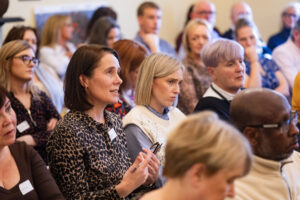
The conference’s objectives were to gain a better understanding of the impact of poverty, disadvantage and discrimination and consider if current strategies and programmes are effective in supporting grant recipients to be as effective as possible in dealing with poverty.
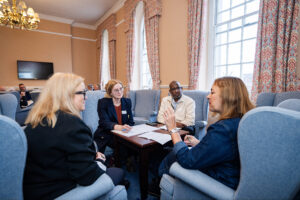
Among the delegates at the event were representatives from Thrive Newtownabbey, a collaboration of parents, schools, community groups and statutory and voluntary organisations working together to help local children and young people to do well. They were joined by Hilltown Community Association’s HEARTH Project, (in conjunction with Rural Community Network), which aims to develop and deliver heritage projects to improve the village and surrounding areas. Both groups talked about the advantages of working collaboratively for positive outcomes and highlighted some of the recent success stories within their respective projects.
Welcoming the guests, Paula Reynolds, Chief Executive of the Belfast Charitable Society, said that poverty was the ‘most disempowering force on earth’ and spoke about the ongoing homeless crisis, benefits caps, burn out experienced by teaching and third sector staff and the knock-on effects on mental health. And she told of the need for changes within society and more advocacy on the part of funders.
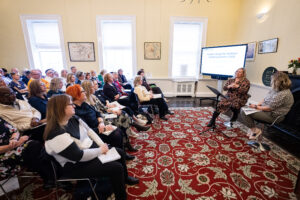
Lived experience of poverty was outlined in a frank and powerful keynote by special guest, Dr Katriona O’Sullivan. In a discussion with journalist Tara Mills, Katriona, whose memoir Poor debuted at number one on the Irish Non-Fiction best seller list, spoke about her life growing up as one of five children in a deprived home in Coventry, shaped by her parents’ heroin addiction.
Katriona left school at 15, fell pregnant the following year, become homeless and cleaning toilets for cash-in-hand to make ends meet. She was also an intelligent and avid reader who went on to graduate from Trinity College, Dublin, with a PHD and become an award-winning academic whose work challenges barriers to education. She is currently a senior lecturer in Maynooth University, a passionate activist and a proud mother.
“With all the will and the hope in the world, I was not expected to be here,” Katriona told the delegates. “I grew up hungry for food, hungry for a hug and for someone to teach me how to regulate my emotions.
“We were really poor and that poverty left me vulnerable to abuse. Children who grow up in poverty are 10 times more likely to be sexually abused, drop out of school and have teenage pregnancies, so I ticked all the boxes.”
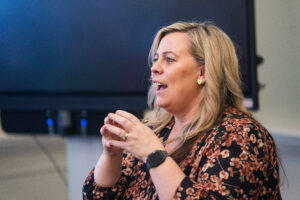
Katriona spoke about being let down by various services time and time again, saying the world outside was more harmful than what was going on at home. But she said she was ‘lucky’ to have had several schoolteachers who believed in her even if she couldn’t see it at the time.
One teacher, Ms Arkinson, from Co Tyrone, offered Katriona much-needed kindness and practical support. She taught her how to wash every morning in school and kept a fresh stack of underwear for her too. Another teacher, Mr Pickering, recognised and encouraged her interest in reading, validating her opinions so she felt seen and heard. Rebellious and hurting, Katriona wasn’t ready to accept the support though, but later recognised the impact both teachers had on her life and her long-term outcomes.
“My childhood was a scary place, and I’d never met an adult capable of putting a light in me.
“But Ms Arkinson lit me up my whole life and made me feel valued. She kept me from the dark thoughts.”
Despite Mr Pickering’s support, Katriona left school early with no qualifications and at the age of 16, became a mum. But Katriona says it was down to his belief in her that she was later able to go to university.
“I could have been seen as a failed intervention, but it’s the lifetime impact of putting a light in someone that matters,” she said. “Sometimes outcomes are in the moment; sometimes they’re 20 years later. But everyone deserves to grow towards the light.”
Katriona told the delegates to trust what the recipients of their funding were telling them about their lived experiences of poverty, advised them of the importance of retaining hope and urged them to ‘keep fighting the good fight.”
And she also suggested ‘flipping the narrative’ around the impact of funding, focusing on “excellence instead of deficit, loss and gap”.
Bringing the conference to a close, Orla Black, chair of Funders’ Forum operations subgroup, spoke of the need for funders and policy-makers, to learn from Katriona’s lived experience of poverty.
She said funders shouldn’t be afraid to take risks and to give themselves permission to fail, reiterating Katriona’s words about the importance of long-term impact.
And reflected the sentiments of funders and recipients alike for the need for a collaborative approach to address poverty and increase advocacy around this complex challenge.
The conference ended on a note of hope with a call to action for funders to shine a light on positive outcomes as opposed to the negatives and number-crunching.
“We are in a hugely privileged position which we need to take seriously,” Orla said. “I think if we have that light and if we have the focus to try and take people’s darkness away, then we should do that.”
The Funders Forum for NI have produced a full conference report, including a series of actions they will prioritise over the next 12 months.
